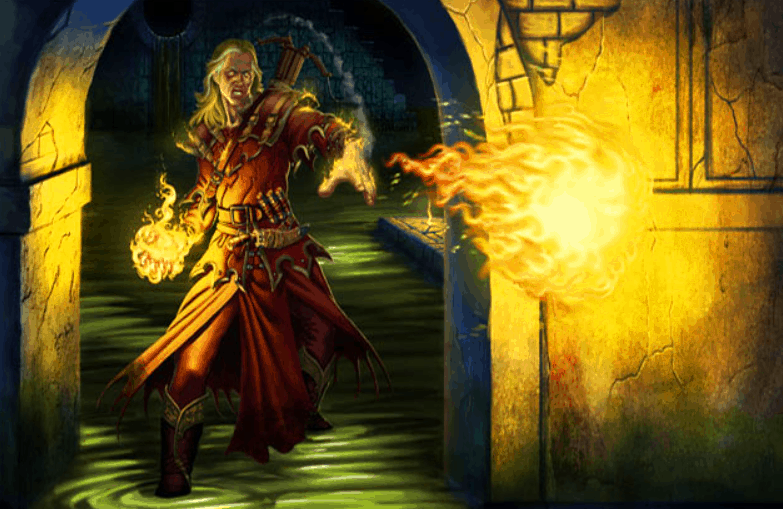
It’s Canon Now: Can a Fireball boil nearby liquids?
During a recent session, a Sorcerer cast Fireball in an effort to injure a primary foe, but as a side benefit hoped to use the spell to boil enemy mutants in their vats of liquid. The question came up: how effectively really is a Fireball in transferring heat energy to nearby liquids?
First let’s look at the spell:

Fireball
Range long (400 ft. + 40 ft./level)
Area 20-ft.-radius spread
Duration instantaneous
Saving Throw Reflex half; Spell Resistance yes
DESCRIPTION: A fireball spell generates a searing explosion of flame that detonates with a low roar and deals 1d6 points of fire damage per caster level (maximum 10d6) to every creature within the area. Unattended objects also take this damage. The explosion creates almost no pressure.
You point your finger and determine the range (distance and height) at which the fireball is to burst. A glowing, pea-sized bead streaks from the pointing digit and, unless it impacts upon a material body or solid barrier prior to attaining the prescribed range, blossoms into the fireball at that point. An early impact results in an early detonation. If you attempt to send the bead through a narrow passage, such as through an arrow slit, you must “hit” the opening with a ranged touch attack, or else the bead strikes the barrier and detonates prematurely.
The fireball sets fire to combustibles and damages objects in the area. It can melt metals with low melting points, such as lead, gold, copper, silver, and bronze. If the damage caused to an interposing barrier shatters or breaks through it, the fireball may continue beyond the barrier if the area permits; otherwise it stops at the barrier just as any other spell effect does.
That last paragraph has some nuggets, but of specific interest is the middle portion: “It can melt metals with low melting points, such as lead, gold, copper, silver, and bronze.” What it doesn’t mention is how much of these metals is melted. Temperature itself doesn’t equal energy, and it’s energy that makes the difference. A spark from a grinder is around 2,000–3,000°F, but it won’t melt a steel beam because it contains almost no thermal mass. Likewise, a blast furnace can melt tons of iron because it delivers enormous energy, not merely high temperature. A Fireball is much more like a flash explosion than a sustained furnace.
A Fireball has the following qualities:
- 20-foot radius (about 33,500 cubic feet, or ~950 m³)
- Instantaneous
- Deals 1d6/level, maximum 10d6 (average 35 hp)
The spell is not intended to ignite everything in that sphere indefinitely. It is a very short-duration thermal pulse. The fact that unattended combustibles ignite tells us the surface temperatures are certainly several hundred degrees Celsius. The fact that it can melt lead, tin, bronze, silver, copper, and gold tells us localized temperatures exceed roughly 1,000°C (1,830°F). But how do we determine total energy expenditure?
Does a Fireball compare to TNT?
Suppose we estimate Fireball by comparing it to a real explosion. A hand grenade releases about 0.8 megajoules of energy (MJ). A 155 mm artillery shell releases around 10 MJ. A small fuel-air explosion may reach 100 MJ. A Fireball:
- fills a 40-foot diameter sphere
- has essentially no blast pressure
- produces intense heat
- causes moderate structural damage only to combustibles
That suggests something in the neighborhood of 10–50 MJ, which feel like it would be much less than most people intuitively imagine.
Can we use the Metal-Melting Statement?
Suppose Fireball melts one pound of copper.
- Copper:
- Specific heat: 0.385 J/g°C
- Latent heat of fusion: 205 J/g
Raise 454 g from room temperature to melting:
- ≈190°C? Actually to 1085°C:
- 454 × 0.385 × 1065 ≈ 186,000 J
Fusion: 454 × 205 ≈ 93,000 J
Total: ≈280,000 J
So melting one pound of copper requires only about 0.28 MJ. To melting ten pounds is ≈2.8 MJ. Not huge!
What does the damage output say?
Humans can absorb roughly 80–100 kJ before suffering unsurvivable burns over most of their body. Fireball deals an average of 35 damage, so if we interpret damage as literal tissue destruction (which RPGs generally don’t), we’d need several megajoules delivered to each target. But damage clearly isn’t literal energy. Otherwise swords would require immense kinetic energies. So damage cannot really be used as a physics conversion.
Putting all this together, I’d estimate a classic Fireball contains on the order of 20–40 megajoules released over perhaps one tenth of a second. This would:
- ignite wood
- scorch stone
- melt small objects of low-melting metals
- badly burn creatures
- produce spectacular flames
without reducing buildings to rubble.
So what about the liquid in the vats?
Here’s where duration matters enormously. The vats in question were 5 x 5 x 4, or about 100 cubic feet of liquid, or approximately 748 gallons of water. But for mathematical simplicity, let’s say the vats are stone and each contains 100 gallons. Water’s heat capacity is immense, and a Fireball might dump only a small fraction of its energy into the liquid because:
- much of the energy radiates outward,
- much heats the stone,
- much heats the air,
- much is absorbed by creatures.
The top inch of liquid might briefly reach boiling; steam might erupt dramatically. But the entire vat? Almost certainly not. If the vats contain:
- Water: The upper few centimeters flash into vigorous boiling. Steam obscures vision briefly, and anyone leaning over the vat risks minor scalding.
- Oil or alcohol: Much more dangerous. Some oils may ignite if their flash point is exceeded. Alcohol vapors could flare dramatically.
- Acid: Depending on the chemistry, you might get a cloud of corrosive vapor.
- Alchemical reagents: All bets are off
END RESULT:
- A classic Fireball contains on the order of 20–40 megajoules released over a tenth of a second. ka-WHUMP.
- That would be enough to melt about 100 pounds of copper, under perfect melting conditions
- It would not be enough, however, to flash-steam 100 gallons of liquid. It would flash boil about 31 gallons of the surface – about the top 2 inches.