A Statistical Analysis of Energy Resistance in Pathfinder 1e
This is the latest of my screeds to optimize the Warlock Vigilante archetype in Pathfinder 1e. It is often said that ER is killer for this particular archetype and that resistances will kill your damage per round, however, I couldn’t find any numerical resources or data on Energy Resistance of creatures in the Bestiary so I went ahead and made my own.
The following figures and lines should include all the information one could ever want to know about Energy Resistance as it appears within the Bestiary. This guide, while initially made for my own quest for the Warlock, is broadly applicable to a class which relies on energy damage for their offensive power. So, without further ado, here is the guide to Pathfinder 1E Energy Resistances.
The Prevalence of Energy Resistance
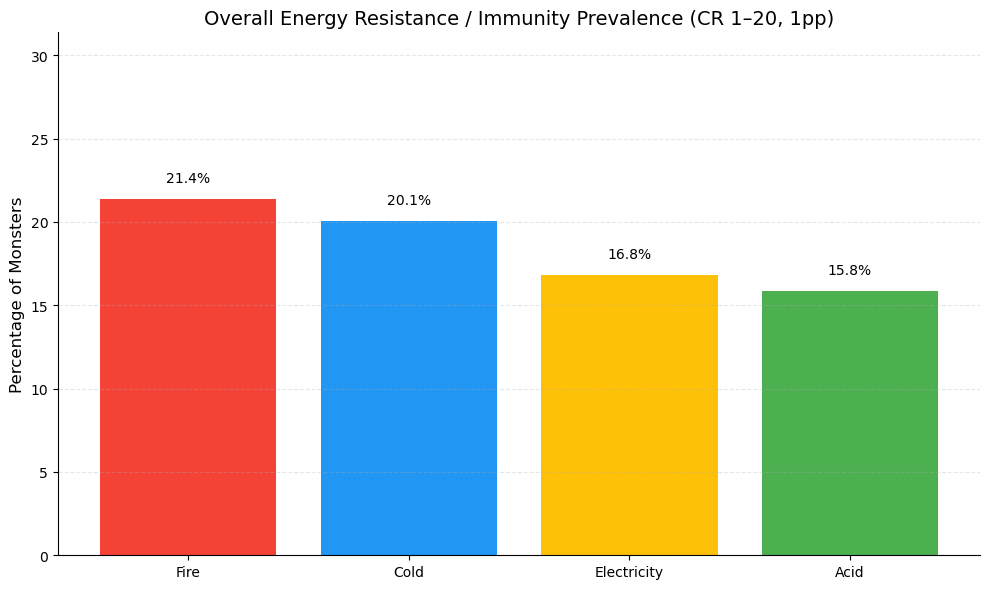
Figure 1: Energy resistances and immunities are sorted from most to least prevalent within the general bestiary.
Whenever anyone asks, “What energy type is best?” the most often given answer is Acid; however, I’ve never seen anyone back this up with any type of data or hard evidence. Well, now we have it!
This answers a singular, fundamental question about energy resistance, but I think there is a greater degree of nuance we can add to the subject to really get down to the finer points. To this end, I wanted to understand how this changed over the period of a game. More specifically, I wanted to understand how the rates of these immunities changed with CR. That question leads me nicely into Figure 2.
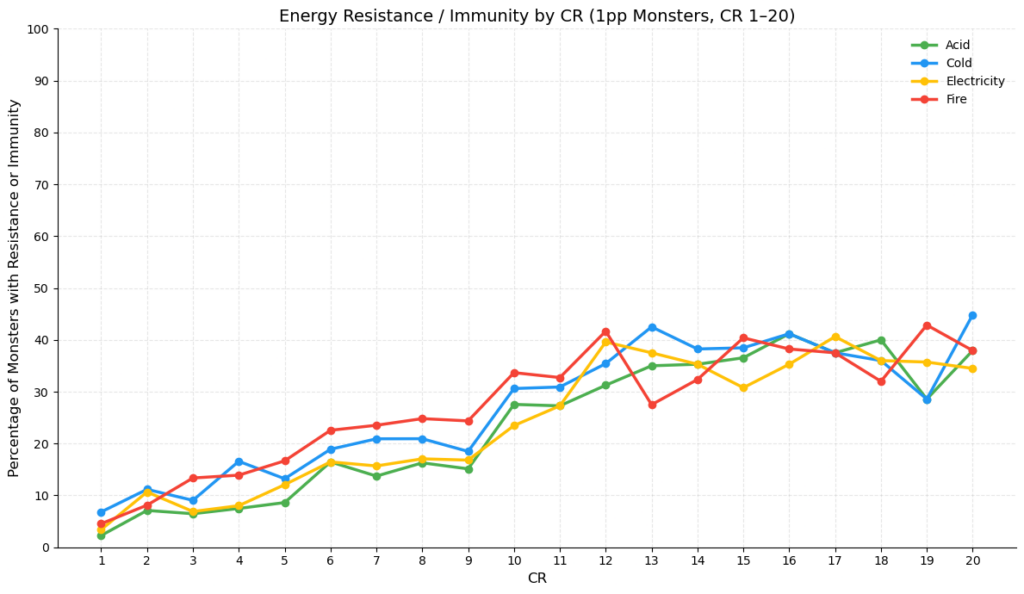
Figure 2: Here, the rates of resistance to each individual energy type are plotted on the y-axis, and CR is plotted on the x-axis. This enables us to see how these singular resistances change over the course of a given campaign.
In Figure 2, we see a fairly consistent general increase in the rates of ER as CR increases. This was expected. Interestingly, we observe that at CR 20, the rate of a creature having ER is below 50% for all energy types. This is likely due to both a small sample size of creatures as CR increases and a genuine lack of ER at this particular level. To verify this, I went ahead and looked at CR 20 creatures in the bestiary myself and was surprised by how few had ER to all energy types. I had, at the very least, assumed that most would have ER 10 (all), but I am pleasantly surprised by this result.
Practicalities of Energy Damage
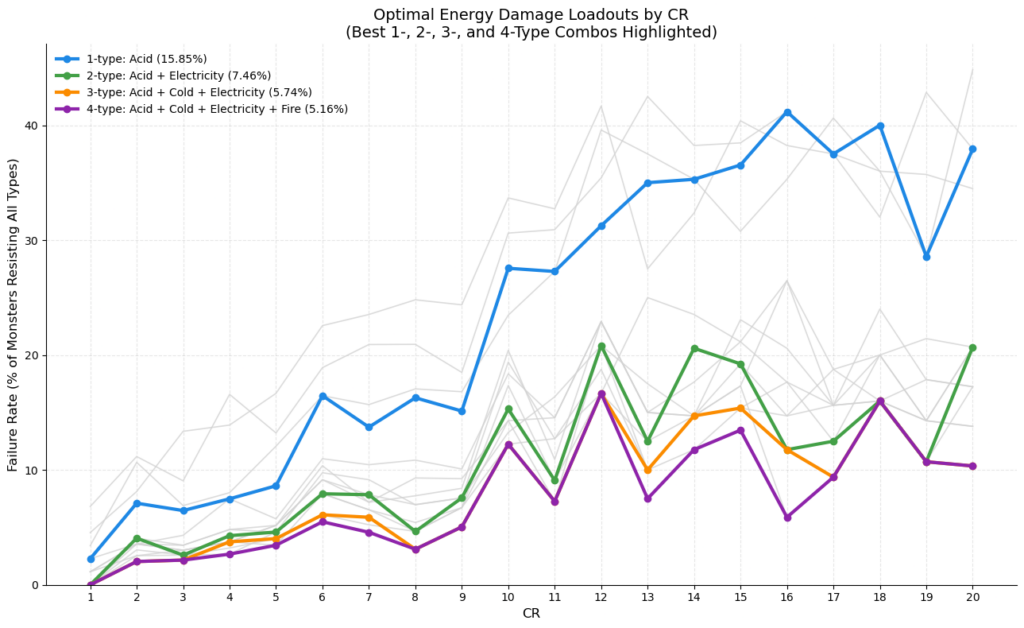
Figure 3: The above figure shows the probability of “failure” for an energy type or combination averaged over the bestiary. In this case, “failure” represents the probability that the energy type (or combination) is resisted or the creature is immune. The gray lines in the background are those with higher combined probabilities of failure.
Figure 3 is designed to answer the question, “If I could prepare multiple energy types, which would be the best to prepare?” Here, we see that Acid is the best single energy type (following logically from previous findings) followed by Acid and Electricity, then Acid, Electricity, and Cold, and finally full elemental coverage.
This general result isn’t wildly surprising, but the numerical values are. Here, by preparing just two energy types, you can maintain full effectiveness for over 92% of the bestiary. These returns diminish as one adds more elements, to a total effectiveness of approximately 95% for all elements.
Immunities
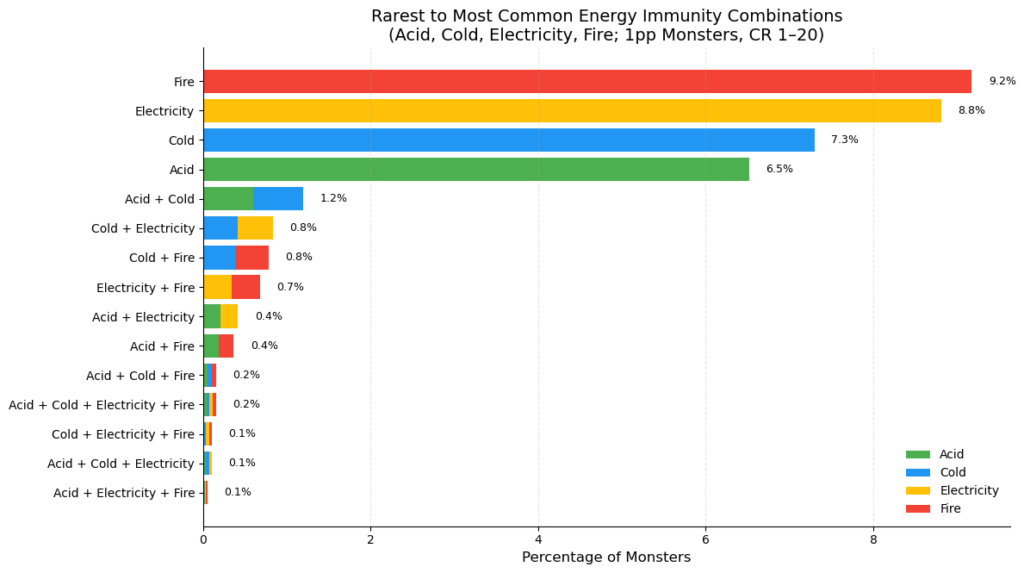
Figure 4: The above figure illustrates the prevalence of energy immunities of different types within the bestiary. These are organized from most common at the top to least common at the bottom.
A brutal 9% of the entire bestiary is just straight immune to fire. Funnily enough, immunity to Acid, Electricity, and Fire is actually rarer than full immunity to all elements. However, both are extremely rare, with there only being 1 and 3 in each category, respectively.
Average ER Values
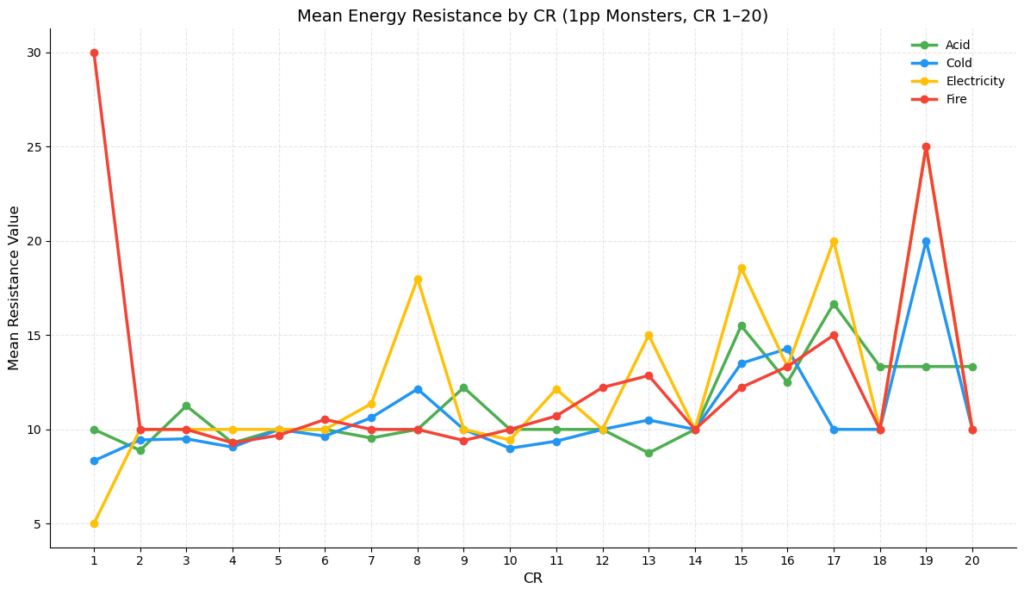
Figure 5: The above plot illustrates the mean value of ER for each energy type per CR among creatures who have ER. In this case, immunities were not considered.
Here, we see that values for ER, in general, hover around 10 when creatures have it. This really isn’t the worst, but avoiding it altogether is still optimal. Interestingly, there are large spikes in Electricity resistance at particular CR levels. Additionally, ER begins to ramp up considerably at CR 15, but it really doesn’t persist for very long.
The huge outlier at CR 1 is the Akata, the only 1pp CR 1 creature with ER to Fire.
Conclusions
As a first order, we can conclude that ER is not as ubiquitous as one might initially believe. However, do not take this as gospel. This is highly dependent upon the types of enemies you will be largely fighting in a campaign. Just because cold isn’t a super common energy resistance generally, that doesn’t mean you should bring it to an undead campaign. If you want to focus on energy damage in a campaign with many creatures of one type, you should make sure that those creatures don’t resist that type. I would imagine this was already common knowledge.
Second, rates of ER will increase along with the CR of encounters. As such, if one is building for offense based around energy damage, one shouldn’t put all of their eggs in a single elemental basket (Unless you have the power to blast through ER). Your effectiveness with energy damage (the probability of being able to bypass ER altogether by using a different element) will triple if you can just manage to prepare just one other type of energy damage.
Third, values for ER, on average, hover around 10 for most creatures across most energy types. In practice, this means that if you are not able to circumvent ER through the use of another energy type, you should expect your damage to suffer by at least 10.
In totality, this guide really only gives a numerical basis to claims that have existed in the Pathfinder 1e community for many years. I do not think much of the information presented here is particularly novel, but I think that it is valuable to have a numerically informed basis for the claims one might make about energy resistance.
The Warlock Supplement
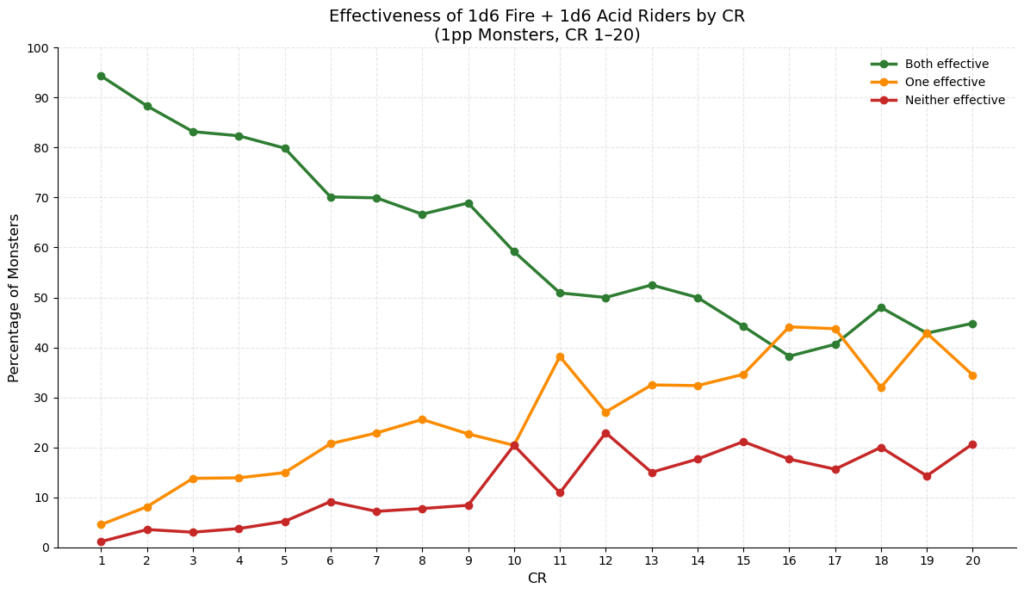
Figure 6: The above figure shows the overall effectiveness of adding 1d6 acid and 1d6 fire from the Deliquescent Gloves and Demonic Smith’s Gloves, respectively. Here, “effectiveness” is defined as the probability that a creature has resistance to neither fire nor acid, with the green line representing resistance to neither, the yellow representing resistance to one, and the red line representing resistance to both.
One of the very few ways to improve the damage of a Warlock’s Mystic Bolt is to use the Deliquescent Gloves and Demonic Smith’s Gloves to add 1d6 acid and 1d6 fire, respectively. Well, I had initially thought this was going to be rather poor, but I wanted to have some data before I made that claim. That question leads to the plot you see above. Surprisingly, both sources of damage apply completely most of the time, 71.27% of the time, specifically. Next, one functions 20.23% of the time, while it is shut out only about 8.50% of the time. Now, I don’t know about you, but I expected this to be much worse. This really is a pretty good upgrade and is like having a slightly worse (but comparable) bane (at least 71% of the time) against everything on your bolts. Pretty nice!
By https://www.reddit.com/user/Outside_Amphibian_38/
Download here: https://docs.google.com/document/d/12EVOfV4jaKPP8OgrmeH92B1dn1_2HBJD9MS_NPlc0TE/edit?tab=t.0